Event Production
Yacht Parties on the Adriatic: Entertainment Guide
Yacht party entertainment on Croatia's Adriatic coast — DJ setups, sound, lighting, routes and real costs for catamaran and superyacht events.
Yacht sound design for the Adriatic — how to solve space, salt, power and zoning on board, and when to bring in a marine AV installer.
Ivan Boban
Updated July 2, 2026
Land-based sound engineering has rules. Yacht sound engineering breaks most of them. The venue moves, the walls don’t exist, the power supply is uncertain, salt corrodes everything, and your audience is simultaneously above, around, and sometimes in the water.
We’ve refined our yacht audio approach across hundreds of marine events on the Croatian Adriatic. This is the technical detail — what works, what doesn’t, and why most first-time boat party organisers underestimate the complexity.
Looking for yacht sound design done for you? This guide covers one-off event setups. For permanent, marine-grade audio built into the vessel — multi-zone systems, salt-resistant components, discreet integration — see our yacht sound design and installation service. For a charter party with a DJ and event sound included, see yacht DJ booking.
A yacht deck isn’t a stage. The DJ setup competes with guest circulation, seating, dining, and safety equipment for the same limited square metres. The audio system has to deliver club-level coverage from a footprint that would barely hold a restaurant background system on land.
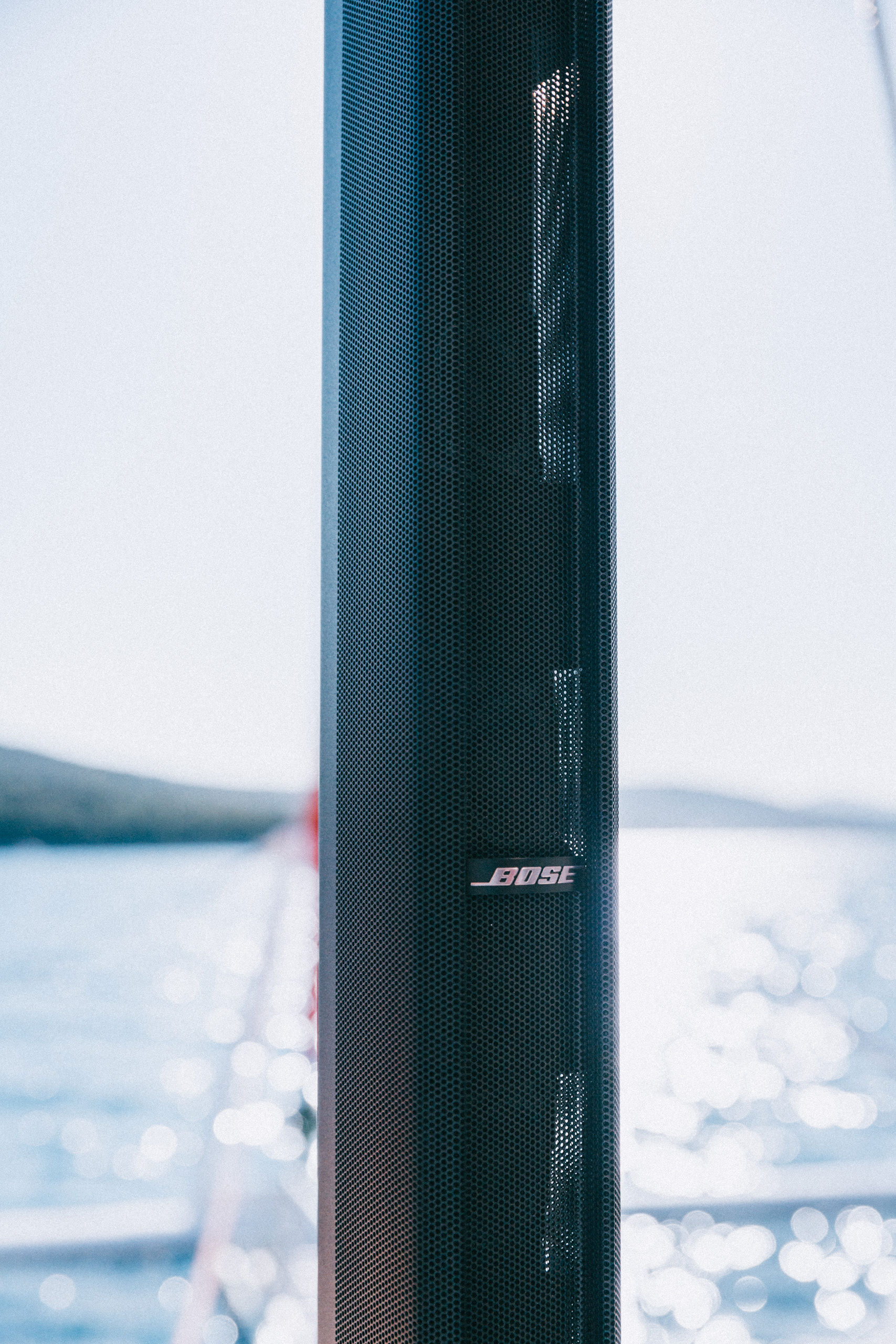
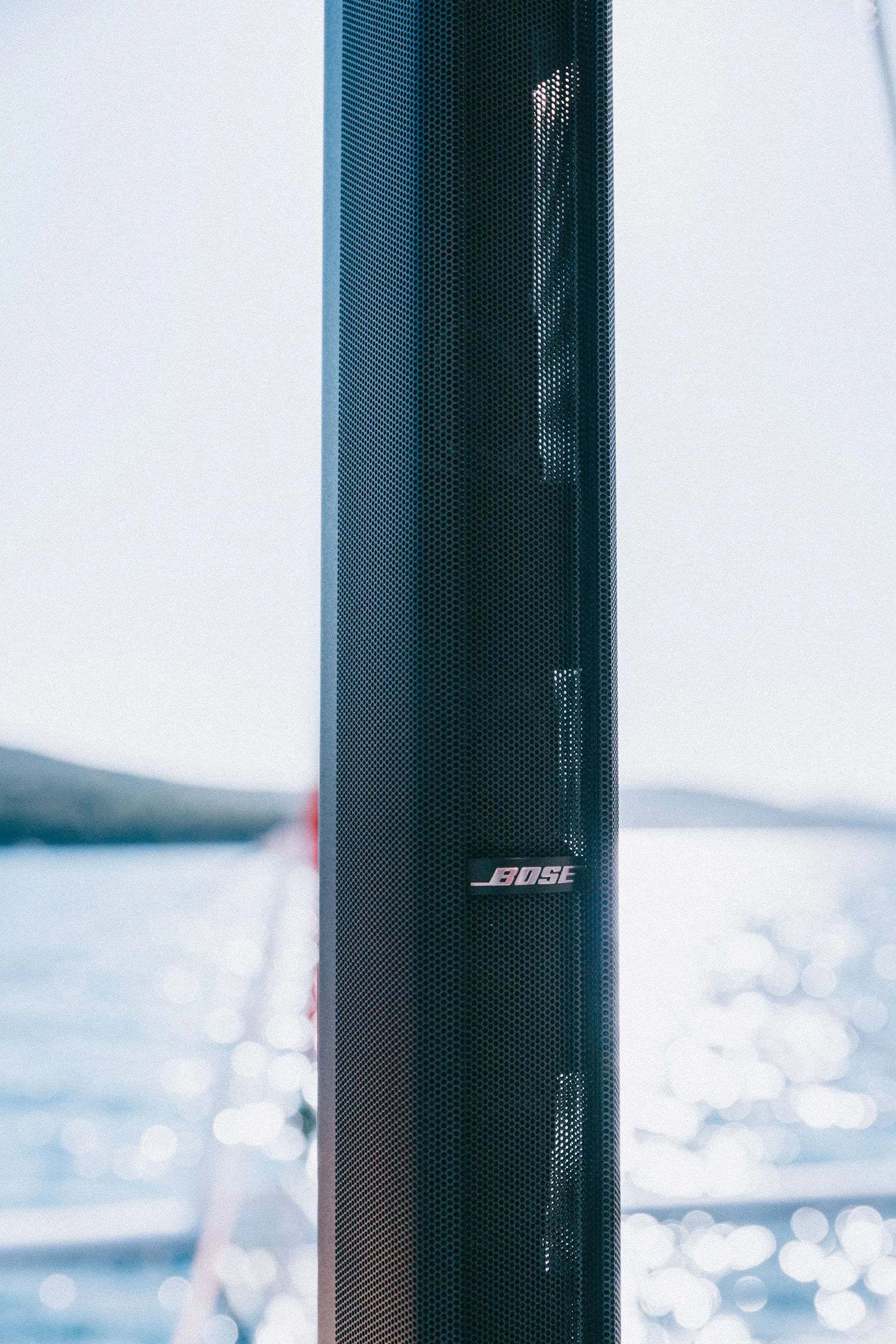
Solution: Column speakers. The Bose F1 Model 812 and Bose L1 Pro series occupy minimal floor space while delivering wide, even coverage. A pair of F1 columns with subs takes up less than 0.5 square metres of deck space and covers 60-80 guests at full outdoor volume.
What doesn’t work: Large box speakers (QSC KW-series, RCF tops) take up too much space and create uneven coverage on a narrow deck. Point-source speakers are designed for rooms with walls that contain and reflect sound — on a yacht, half the sound goes straight into the water.
Most charter yachts provide 220V power through an inverter connected to the vessel’s battery bank or generator. The available amperage is limited and shared with the yacht’s own systems — lights, refrigeration, navigation, air conditioning.
The calculation: A standard DJ setup (controller + 2 active speakers + subwoofer) draws approximately 1,500-2,000 watts. Two LED uplighters add 100-200W. Total: under 2,500W, or approximately 11 amps at 220V. Most yacht inverters can handle this — but confirm with the captain before the event.
The risk: If the yacht’s own systems draw heavily (running air conditioning while docked, for example), the combined load can trip the inverter or blow a fuse. We always carry a backup power distribution board with built-in circuit protection and request a dedicated circuit from the captain.
Battery alternative: For smaller events, the Bose S1 Pro Plus runs 11 hours on internal battery. Two units handle background-to-medium volume for up to 40 guests with zero power requirements. This eliminates the power variable entirely, though at the cost of maximum volume.
Adriatic air carries salt. On a moving yacht with spray, salt deposits form on every surface within hours. Salt is conductive when wet and corrosive when dry — both are bad for electronics.
Prevention protocol:
Long-term impact: Equipment used regularly at sea has a shorter lifespan than land-only gear. We maintain a separate “marine fleet” that gets more frequent maintenance checks and earlier replacement cycles.
Wind is the invisible enemy of yacht audio. Even a moderate 10-knot breeze dramatically affects sound propagation:
Solutions: Position speakers pointing downwind when possible. Use the yacht’s superstructure as a wind break. Boost high frequencies 2-3dB above normal EQ settings. Keep subwoofer levels moderate to prevent hull resonance. Check and adjust EQ throughout the event as wind conditions change.
Yachts move. At anchor in calm conditions, the movement is gentle — but it’s enough to affect equipment:
Every yacht event gets this checklist 48 hours before:
Contact us for yacht sound setup consultation.
Related reading:
Cosmic Production provides marine audio systems for yacht events across the Croatian Adriatic. Browse our equipment.
Yacht party entertainment on Croatia's Adriatic coast — DJ setups, sound, lighting, routes and real costs for catamaran and superyacht events.
Inside Hvar's event and nightlife scene from the production side. Festival work, DJ residencies, venue options.

A production guide to fortress event venues in Croatia. AV challenges, power solutions, logistics.
From AV integration to DJ booking, we provide complete event production services across Croatia.